

Chip stocks stumble, but the long-term outlook remains strong
Semiconductor stocks have come under pressure in recent weeks. The Philadelphia Semiconductor Index (SOX), a widely followed index of semiconductor companies, has fallen by more than 20% from its recent peak. As a result, the index has entered bear market territory. Several well-known names have also seen substantial declines. Nvidia and AMD have declined by around 15%, while Intel and Micron Technology have fallen by more than 30%.
Why have chip stocks fallen?
There are three main reasons behind the recent pullback:
First, investors have been taking profits after a strong rally.
Even after the recent correction, the SOX Index and memory chip producer Micron Technology are still up around 65% and 197%, respectively, since the beginning of the year. Following such gains, a period of profit-taking is not unusual. The latest decline may have been triggered by renewed tensions between the US and Iran, which pushed oil prices higher and revived concerns about inflation and the outlook for interest rates.
Second, investors are questioning the sustainability of the AI investment boom.
Semiconductor companies continue to benefit from the sharp increase in capital expenditure by hyperscalers to build AI infrastructure. However, any doubts about the ability of these companies to generate sufficient returns on their investments could increase volatility in the sector. Recent comments by Meta illustrate this uncertainty. The company indicated that it may rent out part of the computing capacity in its data centres. Some investors interpreted this as a sign of emerging overcapacity, while others viewed it as a logical way to improve returns on infrastructure investments.
Third, potential competition in AI models is increasing.
The Chinese company Moonshot AI recently introduced a large language model. Its performance is close to that of leading Western models from OpenAI and Anthropic, while offering lower operating costs. As AI adoption increases, cost considerations become more important. It remains unclear whether companies will adopt Chinese models or prefer lower-cost alternatives from established Western providers. Concerns related to national security could also influence adoption patterns. The upcoming quarterly results from the hyperscalers may provide more clarity.
Strong fundamentals remain in place
Despite these concerns, the underlying fundamentals for the semiconductor industry remain strong. The backlog for AI-related compute capacity continues to grow, indicating that demand still exceeds supply by a wide margin.
For semiconductor and semiconductor equipment companies such as Nvidia and ASML, this translates into strong order growth and improving visibility on future revenues. The industry is also benefiting from high profit margins and strong earnings growth. Consensus forecasts point to earnings growth for the SOX Index of around 100% in 2026 and 40% in 2027.
Over time, however, chipmakers will expand production capacity and current shortages will gradually ease. Any slowdown in demand could therefore lead to greater volatility. Memory chip manufacturers are particularly sensitive to this, as production capacity can be added relatively quickly, making the segment more cyclical than other parts of the semiconductor industry. Significant capacity expansions are already underway and are expected to become available during the second half of 2027. For now, memory chip prices continue to rise, even in recent days, supporting profitability across the sector. As a result, earnings expectations remain strong.
Valuations also remain reasonable in our view. The SOX Index currently trades on forward price-to-earnings multiples of approximately 26x for 2026 and 18x for 2027. Given the expected earnings growth, these valuation levels do not appear excessive.
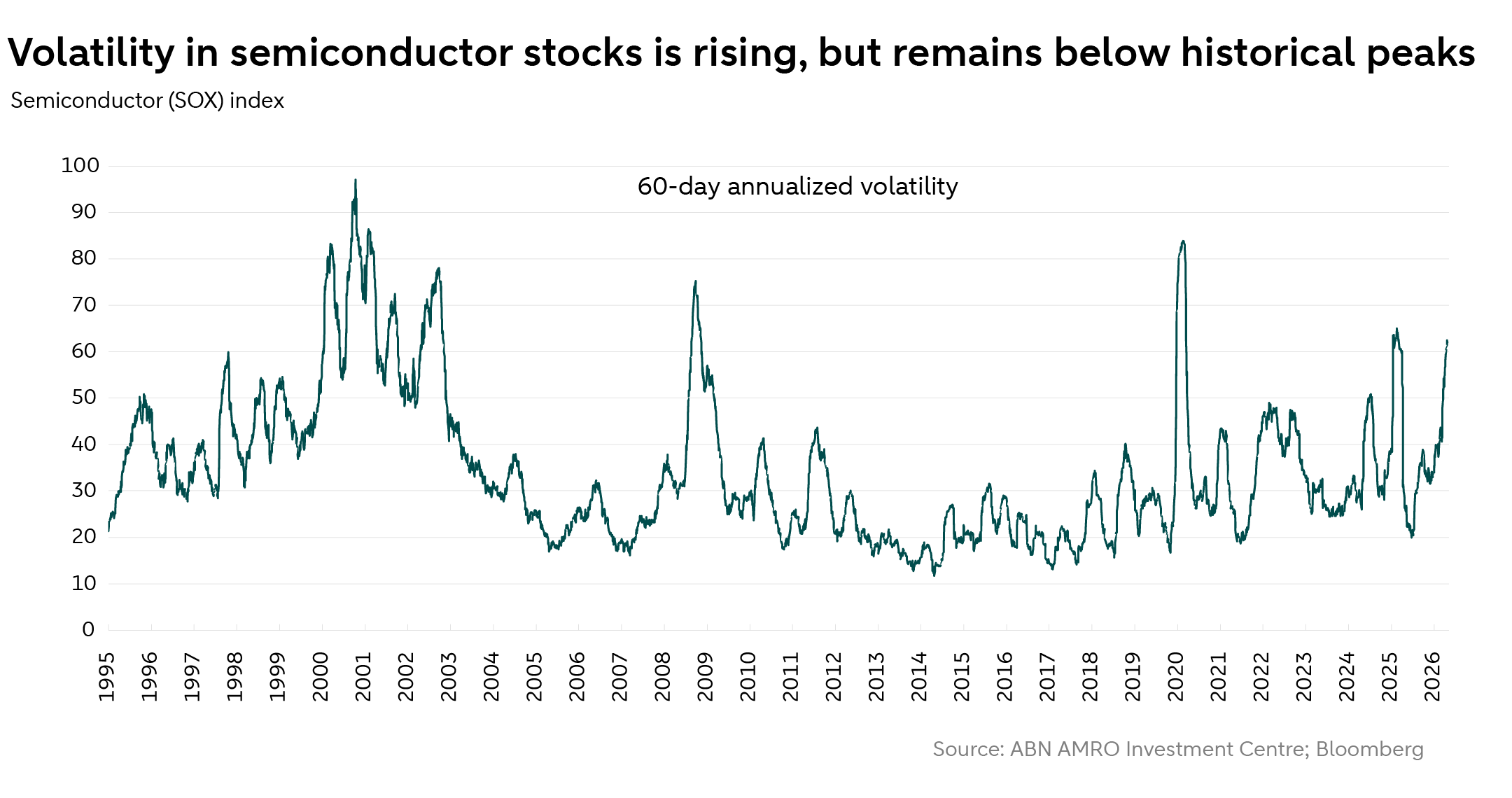
Volatility creates opportunities
The recent correction illustrates that even sectors with strong fundamentals are not immune to periods of volatility. As the saying goes, ‘trees do not grow to the sky’. We have maintained a constructive view on the information technology sector in recent years, reflecting our conviction in long-term trends such as the digitalisation of the economy and the continued development of AI. Our positioning has generally ranged between neutral and overweight. We have also adjusted our exposure when market conditions warranted it. For example, we increased our information technology allocation to overweight in April 2026 and returned to neutral several months later. For now, we maintain our neutral stance. While volatility may remain elevated in the coming months, the recent correction in technology and semiconductor stocks could create attractive investment opportunities in the months ahead.