
You only really learn to steer once the stabilisers come off
A real life story

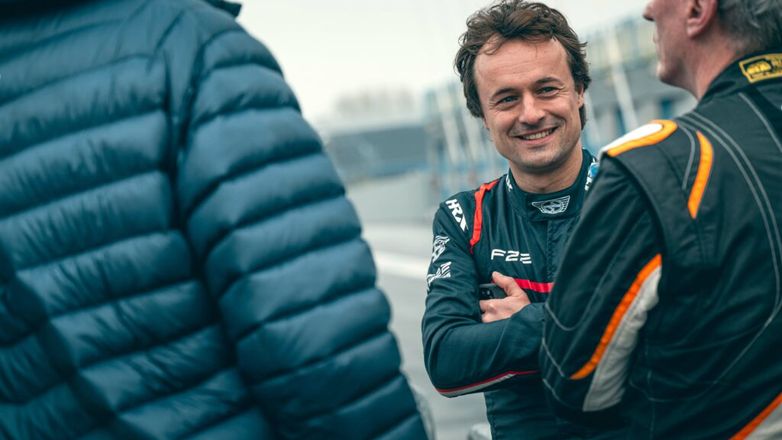
'Donkervoort builds cars that demand everything from you. Just like entrepreneurship itself,' says Denis Donkervoort (38). Since 2021, he has been leading Donkervoort Automobielen as the second generation of the family business — the Dutch sports car brand that impresses worldwide with its extremely lightweight, hand‑built machines. What began as a passion for racing grew into an uncompromising pursuit of perfection and mental balance.
Growing up between motorsport and entrepreneurship
Denis was shaped by motorsport from a young age. 'I grew up on four wheels. Petrol in my veins,' he says. From the age of eight, he was a keen karting enthusiast, competing in Dutch championships and European finals.
At home, it was not only about becoming the best; it was also about entrepreneurship in sport. 'I had to work and save for what I needed, find my own sponsors and negotiate the purchase of my first kart.' His competitive drive did not stay on the track. 'I want to win — even now as an entrepreneur. That’s not always easy for the people around me.'
Different visions
Although Denis and his father Joop share a passion for the company, their approaches differ. 'My father is a real technician, almost a professor. He was always focused on designing a slightly better car, building something just that bit better. It was all about technology, design, engineering. By nature, I’m more the entrepreneur: making sure the organisation is solid and everything works in harmony so the business can grow.'
A succession with clear choices
The handover of the company was a significant moment. Denis explains: 'My father and I realised we had different ideas about where the company should go.' Two captains on one ship was no longer workable, so a choice had to be made. Joop decided to step back: 'Then I’ll stop completely and you should do what you think is needed. With your hands free.'
It was a time full of emotion. 'Was it a euphoric celebration? No,' he says. 'But because you’re family, you can be honest and make the right decisions. Even before that, we often differed in our views. But there’s enormous mutual respect. The most important thing is to do the things you truly believe in and feel comfortable with. You only really learn to steer once the stabilisers come off. Only then do you discover whether you’re ready.'
The Donkervoort DNA
According to Denis, Donkervoort’s uniqueness lies in consistently following its own path. 'Donkervoort does exactly the opposite of what everyone else does,' he explains. 'That may sound stubborn, and it is, but it’s the only way a tiny car manufacturer can stand out.' It’s all about lightweight engineering, technical precision and a pure driving experience where the driver must do the work, the car won’t do it for you.
From mistake to innovation
This uncompromising mindset also led to a new venture. At the Geneva Motor Show in 2007, the roof of the D8 GT began to ripple under the heat of the spotlights. 'Very embarrassing,' Denis admits. But instead of ignoring the mistake, he spotted an opportunity. 'We realised: if foam can generate enough force to deform carbon, can we harness that force?' That idea became Ex‑Core Technologies, now a supplier to Formula 1 teams, defence organisations and superyachts. A 'typical' Donkervoort moment: a problem becomes a patent.
For manufacturers such as Donkervoort Automobielen, strict regulations can make it even more challenging to preserve their 'pure DNA'. Denis is unequivocal: 'For us, ‘no’ hasn’t been an option for 47 years. You see that throughout the company and in the product too.'
No longer a competition — but following his own path
Despite his strong competitive nature, Denis feels little peer pressure from other successful entrepreneurs. He sees too much comparison as a trap. 'I mainly want the freedom to do what I love, to excel at it and enjoy it. Then it’s no longer a competition against someone else, it becomes working on your own happiness.'
Responsibility and continuity
Protecting the family business is a major motivation for Denis. 'My world revolves around protecting this company,' he says. Starting out during the financial crisis made him acutely aware of risk. 'We had to make do with what we had. Everything went into the business. I never want to experience that again,' he explains. That’s why he builds financial buffers and keeps the organisation disciplined.
Wealth provides peace of mind, but it also brings responsibility. 'The more you have, the greater the pressure.' Even so, he prefers to look ahead: 'I focus on good people, a good product and the right direction.'
The future
Looking ahead, Denis has a clear ambition: to grow the brand further without compromising its original character. “No concessions,” he says. International growth is welcome, as long as the essence of the brand remains intact.
And will a third generation eventually take over the company? 'Who knows. As long as they do it with passion, just like we did,' Denis concludes.
Considering the sale of your business or already in the process?
Transferring your business is an important step for you, your family and your company.
Contact
Interested in private banking?

Would you like to get to know us with no obligation and discuss your wishes and goals?
Schedule a meeting directly. We are looking forward to meeting you.
For clients

Do you have a question about your daily banking matters? Please contact Private Assistance:
+31 (0)20 343 43 43 | Wk 8.00am-9.00pm - Sa 9.00am-5.30pm
Would you like to get in touch with your private banker? You'll find their current contact details in your Internet Banking.
Interested in private banking?
Would you like to get to know us with no obligation and discuss your wishes and goals?
Schedule a meeting directly. We are looking forward to meeting you.
For clients
Do you have a question about your daily banking matters? Please contact Private Assistance:
+31 (0)20 343 43 43 | Wk 8.00am-9.00pm - Sa 9.00am-5.30pm
Would you like to get in touch with your private banker? You'll find their current contact details in your Internet Banking.